Dreamforce 2026 & the Integrated GTM Platform
Salesforce announced AIforce, Claudeforce, Hunter, and Agentforce at Dreamforce 2026. Here's what it means for your B2B GTM strategy — and the foundational work that makes AI agents actually produce pipeline.
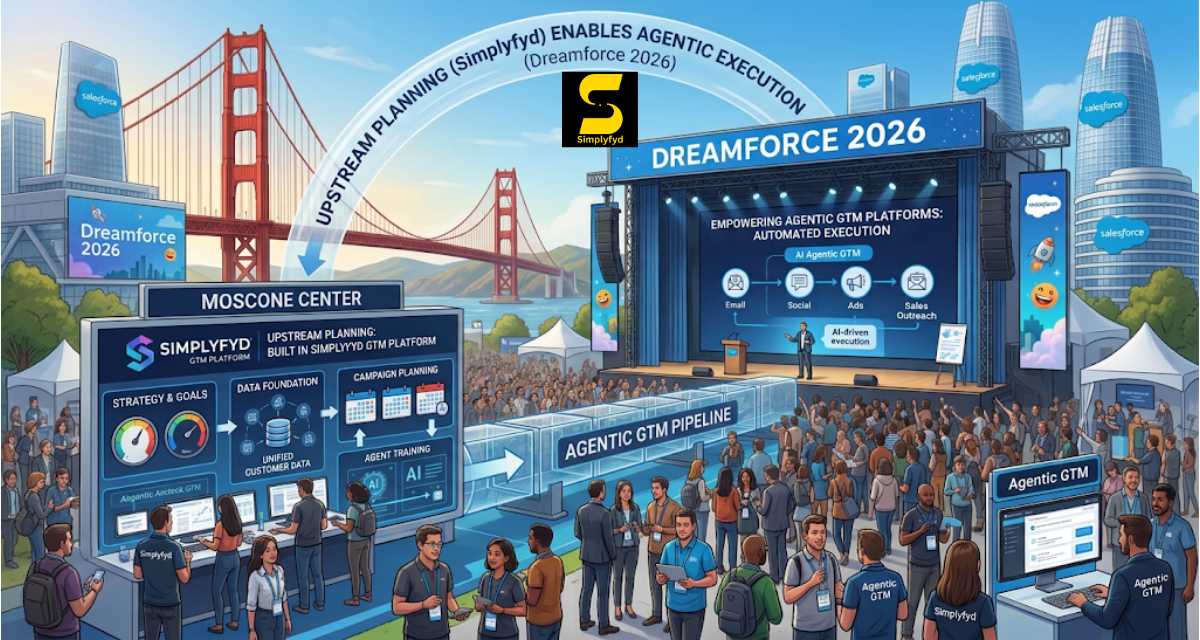
Dreamforce 2026 & the Integrated GTM Platform
By Simplyfyd | GTM Strategy · Revenue Leadership · B2B Growth
TL;DR — Key takeaways
Dreamforce 2026 introduced AIforce, Claudeforce, Hunter, and a portfolio of Agentforce Coworker agents — a deliberate shift from Salesforce as a system of record to Salesforce as a system of autonomous action. The execution layer of B2B GTM is becoming significantly more automated. None of it works without the strategy layer underneath: a precise ICP, validated personas, documented sales plays, and an orchestration layer that coordinates agents with human judgment. That strategy and orchestration layer is where Fractional CRO and CMO leadership becomes more important, not less.
Table of Contents
- What Salesforce Just Announced at Dreamforce 2026
- The Big Shift: From CRM to Agentic GTM Platform
- What This Means for B2B Revenue Teams Right Now
- The Problem Salesforce Can't Solve For You
- The Missing Layer: Human Orchestration
- How Simplyfyd Fits Into the Agentic GTM World
- What B2B Leaders Should Do Right Now
- Frequently Asked Questions
What Salesforce Just Announced at Dreamforce 2026
Dreamforce 2026 wrapped up September 17 in San Francisco with one unmistakable headline: Salesforce told the world its own user interface is optional.
The major announcements centered on a single new architecture called AIforce — a live interface layer designed to bring trusted Salesforce context, data, workflows, permissions, and governance into AI tools like Claude, Slack, and Agentforce Coworker.
Underneath AIforce, three specific products are worth understanding:
Claudeforce — puts Salesforce context and actions directly inside Claude, backed by 37 prebuilt sales skills covering prospecting through pipeline hygiene. In beta for all Salesforce customers as of Dreamforce 2026.
Slackforce — brings Salesforce context and actions directly into Slack conversations and workflows, turning Slack into a working interface for Salesforce — creating records, building live dashboards, and running agents, all from inside a channel.
Agentforce Coworker — a portfolio of seven job-ready AI agents: Piper, Hunter, Carter, Casey, Fin, Marshall, and Paige — covering B2B sales prospecting, service, commerce, HR, and supply chain operations. Hunter, the B2B prospecting and outreach agent, is built with a long-horizon runtime designed to sustain deal cycles over several weeks. It is in pilot with general availability expected in November 2026.
And then there's Koa — Salesforce's first CRM reasoning model, built with NVIDIA on Nemotron 3 Super and currently in pilot — a model designed to reason specifically about CRM data and enterprise workflows rather than general knowledge. General availability is targeted for winter 2026 in US regions.
The larger message: Salesforce wants CRM data and business processes to be available wherever employees and AI agents work — not locked inside the traditional Salesforce interface.
This is not a feature update. It is a platform shift — and it has direct implications for how B2B companies build and run their go-to-market motion.
The Big Shift: From CRM to Agentic GTM Platform
For the last two decades, the CRM sat at the center of the B2B revenue stack. Data flowed into it. Reps logged activity in it. Managers pulled reports from it. Marketing connected to it through integrations that ranged from elegant to nightmarish.
The CRM was the system of record. It was not, however, the system of action.
What Salesforce announced at Dreamforce 2026 is a deliberate attempt to close that gap. The "Agentic Enterprise" vision positions AI agents, data, applications, and people converging to deliver measurable business value — not just record it.
In practical terms, this means:
- AI agents that can prospect, qualify, and nurture opportunities autonomously — not just log when a human rep did
- CRM data and workflows accessible directly inside the AI tools revenue teams already use — Claude, Slack, email
- A reasoning model (Koa) purpose-built to understand CRM context, pipeline dynamics, and deal progression
- Marketing Cloud Next, a complete rebuild of the marketing platform on Salesforce core and Data 360 — eliminating the connector architecture that previously separated marketing data from CRM data — with a Campaign Agent that creates campaigns autonomously from a briefing
If it works as advertised, the result is a platform where the CRM doesn't just store your GTM motion — it executes it.
That is a meaningful shift. And for B2B companies building a revenue engine right now, it raises an immediate question: does this change what you need to do, or just how you do it?
What This Means for B2B Revenue Teams Right Now
Let's be direct about what Dreamforce 2026 changes — and what it doesn't.
What changes:
The execution layer of your GTM motion is about to become significantly more automated. Tasks that required dedicated SDR time — initial prospecting, outreach sequencing, pipeline hygiene, meeting scheduling, follow-up cadences — are increasingly addressable by AI agents.
Hunter's long-horizon runtime means it isn't just sending one email. It's managing a prospecting motion over weeks. The Campaign Agent compresses the time from marketing brief to live campaign significantly. And with Claudeforce, your revenue team can access CRM context, run plays, and update pipeline without switching between systems — less friction in the execution layer means more time available for the conversations that require human judgment.
What doesn't change:
None of this works without the foundational strategy layer that sits underneath it.
AI agents need an ICP to target. They need buyer personas to personalize messaging. They need sales plays to know what to do when a deal stalls, a competitor makes a move, or a CFO raises an objection the sequence doesn't cover.
One of the most important observations coming out of Dreamforce 2026 is that the messaging leaned hard on "agentic" adoption, but offered almost no customer ROI figures or cost-to-run numbers for Agentforce in production. The agents are impressive. The question every revenue leader should be asking is: impressive at executing what, exactly?
A Hunter agent prospecting to a vague ICP is faster spam. A Campaign Agent creating campaigns without a validated positioning statement produces more content that doesn't convert. The intelligence of the agent is bounded by the quality of the strategy it's executing.
The Dreamforce 2026 announcements accelerate the execution layer. They do not build the strategy layer. That remains a human — and specifically a revenue leadership — problem.
The Problem Salesforce Can't Solve For You
Here's the uncomfortable reality that no keynote addresses.
The B2B companies that will get the most out of AIforce, Claudeforce, and Agentforce Coworker are not the ones that adopt these tools first. They are the ones that had their GTM foundations in place before the tools arrived.
Think about what an AI agent actually needs to work:
To prospect effectively, it needs a precise ICP — specific enough to identify the right companies, the right contacts, and the right trigger events that indicate buying readiness. "Mid-market B2B companies" will produce a Hunter agent that prospects to 50,000 companies with a generic message. A trigger-based ICP — "Series B SaaS companies, VP of Sales hired in the last nine months, using Salesforce, in the US" — produces an agent that prospects with surgical precision.
To personalize outreach, it needs buyer personas mapped to real concerns and fears — not job titles. The CFO's concern is different from the VP of Sales's concern. An agent given only a job title will produce outreach that is technically customized and substantively generic.
To handle deal situations, it needs documented sales plays. When a deal stalls because a competitor made a move, what does the agent do? If the play isn't documented, the agent defaults to the generic cadence — which is exactly the problem we've been trying to solve all along, now automated at scale.
To operate across the buying committee, it needs an orchestration layer — a set of rules that coordinate who says what to whom, when, through which channel, and in what sequence. Without orchestration, multiple agents touching the same account produce contradictory, redundant, or poorly timed outreach.
The AI agents Salesforce announced at Dreamforce 2026 are powerful execution mechanisms. Execution mechanisms amplify the system underneath them. If the system is strong — precise ICP, validated personas, documented plays, coordinated orchestration — the agents multiply your revenue team's effectiveness. If the system is weak, the agents multiply the noise.
This is the same principle that governs every tool in your stack. Dreamforce 2026 didn't change it. It made it more consequential.
For a deeper look at building that foundation, see our guide on the B2B GTM blueprint.
The Missing Layer: Human Orchestration
There is a layer that sits between your GTM strategy and your AI execution tools — and it is the layer most B2B companies have not yet built.
Call it the orchestration layer. It is the operating system that translates strategy into action — defining not just what the agents should do, but when, why, to whom, and in what coordinated sequence with the rest of the revenue team.
Orchestration is not a tool. It is a discipline. And it requires human judgment at four levels:
Strategic judgment — deciding which ICP to target, which trigger to use as the activation signal, which plays to run in which situations, and which metrics determine whether the motion is working.
Messaging judgment — determining what each buyer persona needs to hear at each stage of the buying journey, and how the agent's outputs need to be calibrated to create resonance rather than noise.
Competitive judgment — understanding the competitive landscape well enough to know when to run a differentiation play, how to reframe the decision criteria, and when to escalate to executive engagement rather than letting the agent continue the sequence.
Relationship judgment — knowing when a deal has moved beyond what an AI agent can handle: when the CFO needs a peer conversation, when the champion needs enablement that goes beyond what a Hunter sequence provides, when the personal relationship dimension of the sale requires a human in the room.
This is precisely the work a Fractional CRO or Fractional CMO does. Not managing the execution tasks that AI agents are increasingly capable of handling — but building and calibrating the strategy and orchestration layer that makes the agents effective.
The Dreamforce 2026 announcements don't reduce the need for senior revenue leadership. They change what that leadership is responsible for: away from managing execution tasks agents can now handle, toward the strategic and judgment-intensive work that determines whether those agents are pointed at the right targets, with the right message, running the right plays.
How Simplyfyd Fits Into the Agentic GTM World
At Simplyfyd, we build what we call a Unified Revenue Engine — the integrated GTM system that connects ICP, positioning, sales plays, and orchestration into a coordinated motion.
In the agentic world Salesforce announced at Dreamforce 2026, that work becomes more important, not less. Here's where each Simplyfyd offering fits:
Fractional CRO The strategic layer that defines what the agents execute. Precise ICP with documented trigger events. A sales play library for each deal situation. Revenue metrics that separate signal from noise. Orchestration rules that coordinate the AI execution layer with the human relationship layer.
In a world where Hunter is prospecting and Agentforce Coworker is running initial sequences, the Fractional CRO's role shifts from managing those activities to designing the strategy they execute — and monitoring the metrics that determine when to intervene, adjust, or escalate.
Fractional CMO The messaging and positioning layer that determines whether the Campaign Agent creates campaigns that convert or campaigns that produce impressions. AI-generated campaigns built on validated positioning and persona-mapped messaging work. AI-generated campaigns built on generic value propositions produce more content that underperforms.
Marketing Cloud Next's ability to unify marketing and CRM data is a significant capability — but the insight that drives campaign creation still requires human marketing leadership to define. What problem are we solving for which persona at which stage of the buying journey? That is a strategic question an agent can execute on but cannot answer.
Onshore Sales Support The human relationship layer that covers the dimension of complex B2B deals AI agents cannot yet handle: the executive peer conversation, the skeptic engagement, the champion enablement session, the final negotiation where relationship and judgment matter more than process.
Hunter can run a prospecting sequence for weeks. It cannot have the conversation a CFO needs to have with a peer before committing to a significant vendor engagement. It cannot read the room in a multi-stakeholder presentation and adjust the narrative in real time. It cannot build the kind of relationship that makes a client renew not just because the product works, but because they trust the people behind it.
Onshore sales support — US-based professionals with the cultural fluency, relationship skills, and contextual judgment that complex B2B deals require — remains the execution layer for the parts of the revenue motion that require genuine human engagement.
GTM Strategy The blueprint that all of the above executes against. ICP definition, positioning, channel selection, play development, metrics architecture. The strategy that ensures AIforce, Claudeforce, and Agentforce agents are pointed at the right targets, with the right message, running the right plays, measured against the right outcomes.
In an agentic world, the quality of the GTM strategy is the primary determinant of revenue performance. The execution layer is increasingly automated. The strategy layer is the irreducible human contribution.
What B2B Leaders Should Do Right Now
The Dreamforce 2026 announcements are not a reason to wait. They are a reason to accelerate the foundational work that makes the new tools valuable when you adopt them.
Here is what to prioritize in the next 90 days:
Audit your ICP. Is it specific enough that Hunter could use it to build a targeted prospect list without human interpretation? If not, tighten it — add the trigger event, define the negative ICP markers, get it to a level of precision that drives automated targeting decisions. Our ICP audit guide walks through how to run this exercise.
Document your sales plays. Before Agentforce agents can run plays autonomously, the plays need to exist in documented form. Define your five most common deal situations and the coordinated response to each. These become the behavioral instructions that govern what the agents do when they encounter each situation. See our guide on sales plays that actually convert.
Map your buyer personas to fears, not job titles. Campaign Agent and Hunter will personalize outreach based on the persona information you give them. If that information is job title and demographic, the personalization will be shallow. Map each persona to their specific concern, their specific fear, and their specific definition of success — and the personalization becomes substantive.
Unify your data. Marketing Cloud Next eliminates the connector gap between marketing data and CRM data — but only if your data is clean, consistently structured, and governed with clear permissions. The agents are only as good as the data they reason over. Data hygiene is not a back-office concern. It is a revenue performance concern.
Identify the human relationship layer. Be intentional about which parts of your revenue motion require human judgment and relationship — and resource them accordingly. The agentic tools handle prospecting, sequencing, and pipeline hygiene. The human layer handles executive relationships, complex deal navigation, and the moments where judgment and trust matter more than process.
Consider fractional revenue leadership. The transition to an agentic GTM motion requires senior revenue expertise — to design the strategy the agents execute, to build the orchestration layer that coordinates them, and to manage the human relationship layer that remains irreducibly important. For companies at Series A to Series C, Fractional CRO and CMO leadership provides that expertise without the cost and commitment of a full-time executive hire during a period of significant platform transition.
Frequently Asked Questions
What is AIforce and why does it matter for B2B GTM?
AIforce is Salesforce's new interface layer, announced at Dreamforce 2026, that brings Salesforce data, workflows, business logic, permissions, and governance into AI tools like Claude, Slack, and Agentforce. For B2B GTM, this means CRM context is no longer locked inside the Salesforce interface — it is accessible wherever your revenue team works. The practical implication: AI agents can now access and act on real CRM data, making automated prospecting, outreach, and pipeline management significantly more contextually informed.
What is Claudeforce?
Claudeforce is the integration between Salesforce and Anthropic's Claude, announced at Dreamforce 2026. It puts Salesforce context and actions directly inside Claude, with 37 prebuilt sales skills covering prospecting through pipeline hygiene. In beta for all Salesforce customers as of Dreamforce 2026, with more skills for service, marketing, and commerce expected to follow.
What is the Hunter agent and should B2B companies use it?
Hunter is Salesforce's Agentforce agent for B2B prospecting and outreach, with a long-horizon runtime designed to manage multi-week prospecting motions autonomously. It is in pilot as of Dreamforce 2026 with general availability expected in November 2026. B2B companies should evaluate it — but effectiveness depends entirely on the quality of the ICP, buyer personas, and outreach strategy it is given to execute. A Hunter agent with a vague ICP produces automated noise. A Hunter agent with a precise, trigger-based ICP produces accelerated qualified pipeline.
Does AI agent adoption reduce the need for a fractional CRO or CMO?
No — it changes the nature of the work. As AI agents increasingly handle execution tasks — prospecting, sequencing, campaign creation, pipeline hygiene — the strategic and judgment-intensive work of revenue leadership becomes more important, not less. The Fractional CRO's role shifts toward designing the ICP, building the play library, calibrating the orchestration layer, and managing the human relationship dimension of complex deals. The Fractional CMO's role shifts toward positioning strategy, persona mapping, and ensuring AI-generated campaigns are built on validated messaging rather than generic value propositions.
How does Marketing Cloud Next change B2B marketing?
Marketing Cloud Next, announced at Dreamforce 2026, is a complete rebuild of Salesforce's marketing platform on Salesforce core and Data 360 — eliminating the connector architecture that previously separated marketing data from CRM data. For B2B marketing, this means a unified view of prospect and customer data across marketing and sales, with a Campaign Agent that creates campaigns autonomously from a marketing brief. The strategic foundation of what campaigns to create, for which personas, with which message, remains a human marketing leadership responsibility.
What is Koa and how does it differ from general AI models?
Koa is Salesforce's first CRM reasoning model, built with NVIDIA and announced at Dreamforce 2026. Unlike general-purpose AI models, Koa is specifically post-trained on CRM and enterprise workflow data, meaning it reasons about deal progression, pipeline dynamics, and customer relationship context more accurately than a general model. In pilot as of September 2026, with general availability expected in winter 2026 in US regions.
What does an integrated GTM platform look like in 2026?
An integrated GTM platform in 2026 combines three layers. The strategy layer — ICP, positioning, buyer personas, sales plays, and orchestration rules — defines what the system executes. The AI execution layer — Agentforce agents, Claudeforce, Marketing Cloud Next — automates prospecting, outreach, campaign creation, and pipeline management at scale. The human relationship layer — onshore sales support, executive engagement, complex deal navigation — handles the judgment-intensive, relationship-dependent dimensions of the revenue motion that AI agents cannot yet replicate. Simplyfyd builds the strategy and human relationship layers, and designs the orchestration that connects all three.
Is Salesforce's Agentic Enterprise vision ready for B2B companies to adopt now?
Partially. Agentforce Coworker, five of the seven job-ready agents, Claudeforce (in beta), and Slackforce (in beta) are available now. Hunter and several other features are in pilot with general availability expected by November to winter 2026. The foundational work — ICP, personas, plays, data quality — should start immediately. Tool adoption should follow the availability timeline and your organization's readiness to provide the strategy layer that makes the agents effective.
How Simplyfyd Helps B2B Companies Navigate the Agentic GTM Shift
The Dreamforce 2026 announcements mark a genuine inflection point in how B2B revenue motions are built and run. The companies that navigate it well will not be the ones that adopt the new tools fastest. They will be the ones that had the strongest strategic foundations before the tools arrived — and who build the orchestration layer that makes those tools execute against a clear, validated, precise GTM strategy.
That is exactly the work Simplyfyd does.
We help B2B technology companies build the strategy layer that makes AI execution tools effective — and the human relationship layer that handles what those tools cannot. Fractional CRO, Fractional CMO, onshore sales support, and GTM strategy — integrated into a single, unified revenue engine.
Ready to build the GTM foundation that makes your agentic tools work? Book a free strategy call
Related reading: