Where Will Next Quarter's Revenue Come From? Why B2B Revenue Plans Fail Before They Start
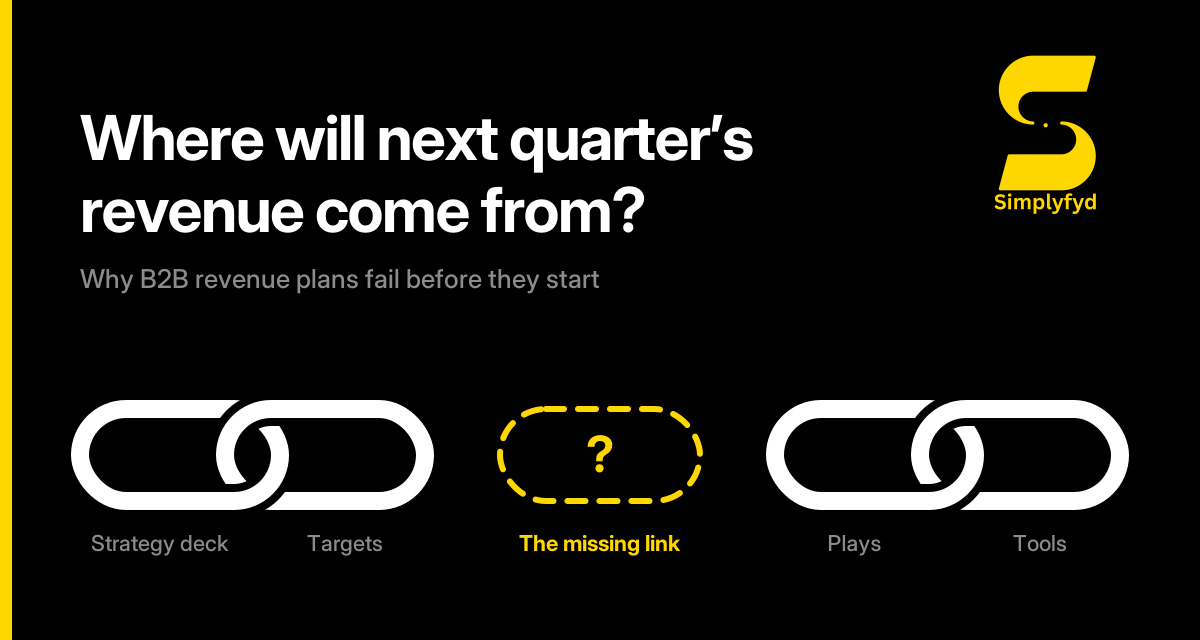
Most B2B tech SMBs have targets, tools and a strategy deck, but nothing connecting them. Here are the three gaps that quietly break revenue plans, and how to close them before 2027.
Where Will Next Quarter's Revenue Come From?
Why B2B revenue plans fail before they start
It's planning season once again. The 2027 targets are set, the board deck is nearly done, and the Sales Kickoff is on the calendar. Yet in most B2B tech companies, one question still makes the leadership team go quiet:
Where, exactly, will next quarter's revenue come from?
Not "what's in the pipeline." Not "what's our target." But which accounts, which plays, which campaigns, and how confident are we that they'll deliver?
In my work with B2B tech SMBs, the honest answer is usually: we're not sure. And it's rarely because the team lacks effort, talent or tools. It's because nothing connects the strategy, the targets and the day-to-day work.
That disconnect shows up in three ways.
1. Strategy lives in decks, not in a system
Every company has done the strategy work. There's an ICP slide, a list of target segments, maybe a messaging framework and a few sales plays. It was presented at an offsite and everyone nodded.
Then it went into a shared drive.
Three months later, reps are prospecting whoever looks promising, marketing is running campaigns based on last year's calendar, and nobody can say which of the plays from the offsite are actually running. The strategy was never wrong. It simply never became something the team could execute and track.
I have seen polished PowerPoints being built to present the GTM strategy to the executives. Once it is presented at the Sales Kickoff meeting, it is relegated to history!
2. Targets exist, but there are no plays behind them
Leadership sets a number: $18M in new revenue next year. It gets split by quarter and by rep. But ask how that number will be achieved and the answer gets vague.
Which accounts will that revenue come from? Is it new logos or expansion? Which campaigns will create the pipeline, and when do they need to start? Which sales plays will convert it?
When targets aren't linked to specific plays and campaigns, the target is really just a hope with a spreadsheet attached. Nobody knows the plan is off track until the quarter is nearly over.
In the sales reviews, the deals are discussed but there is no discussion on how to generate the leads and opportunities. The "how" part is always missing.
3. Plenty of tools, nothing connecting them
Most B2B teams aren't short on software. There's a CRM, an outreach tool, a prospecting database, marketing automation, maybe a forecasting add-on.
Each tool does its job. But each one covers one slice of the work, and none of them connects the target at the top to the activity at the bottom. The CRM tells you what happened in your pipeline. It doesn't tell you which strategy to run, on which accounts, with which plays, or whether it's working.
So the connecting happens in spreadsheets, weekly meetings and the heads of a few senior people. That works until it doesn't.
Why this compounds: the revenue lag
Here's what makes these gaps so expensive in B2B: revenue lags activity by 2 to 4 quarters.
A large B2B deal that closes in Q3 2027 needs to be in the pipeline by Q1, which means the campaign that creates it needs to run now (Q4 2026). A gap in this quarter's plan doesn't show up as a miss this quarter. It shows up as a miss two or three quarters from now, when it's far too late to fix.
That's why the symptoms feel so familiar:
- Forecasts leadership can't trust. Without structured plays behind the pipeline, the numbers are educated guesses.
- Unmanaged revenue lag. Today's planning gaps quietly become next year's missed targets.
- Every quarter starts from scratch. There's no record of which plays worked, so the team can't build on success.
What good looks like
The fix isn't another tool or a better strategy deck. It's connecting the three layers that are currently disconnected.
Every target is backed by a play and a campaign. A revenue number only goes into the plan once you can name the accounts, the sales play and the marketing campaign that will produce it. If you can't, you've found a gap, early, while you can still do something about it.
Marketing and sales run one motion. The campaign that creates demand and the sales sequence that converts it are planned together, as one program with one owner, instead of two teams handing off leads and blaming each other for the results.
Leaders see the gap before the quarter is lost. Forecast versus target is visible at the account level, in real time, so leaders can act on data rather than gut feel, while there's still time to change course.
In practice, that means revenue is traceable from top to bottom:
- The executive team sets the target.
- Leaders allocate it to segments, accounts and teams.
- Sales plays are defined for each, by quarter.
- Programs (a marketing campaign plus a sales sequence) execute those plays in monthly sprints.
When every layer connects to the one above it, you can finally answer the question at the top of this article.
A 10-minute check for your 2027 plan
Before you lock your plan, ask your team these five questions:
- For each revenue target, can we name the accounts it will come from?
- Does every target have a specific sales play and campaign behind it?
- Given our sales cycle, do the campaigns for Q2 and Q3 revenue start early enough?
- Are we planning expansion revenue as deliberately as new logos?
- Will we know a target is at risk in week 4 of the quarter, or week 12?
If any answer is "not really," that's where next year's miss is hiding.
Closing the gap
At Simplyfyd, this is the problem we focus on: turning GTM strategy into a plan that's executed, tracked and connected to the number. Sometimes that means hands-on fractional revenue leadership. Increasingly, it means giving teams a system that does the connecting for them, which is why we built SimplyfydStack, the GTM operating system for B2B tech SMBs.
If you're finalizing your 2027 plan and want a second pair of eyes on where the revenue will really come from, let's talk.